Quality Nickel-Copper-Cobalt-PGE Portfolio Consisting Of

A historic mine in operation 1965-1969 that had a production grade of 3.28% nickel, 1.83% copper and 9.63 g/t platinum-palladium+gold. Historic mine remains open along strike to south, and a new mineralized zone was discovered 500 meters west-northwest of the historic Rottenstone mine in 2021. A historic nickel-copper mineral resource, the historic Gochager Lake deposit, defined 1966-1968. Drilling in 2023 discovered steeply oriented chutes of high-grade nickel-copper mineralization with very significant cobalt credits within the deposit. The Gochager Lake deposit open for expansion in all directions.

Proven Exploration Team

Very experienced, highly motivated team of nickel-copper-cobalt-PGE experts with world-wide experience exploring for, discovering and researching magmatic nickel sulphide deposits. Management proven track record of discovery, developing and executing takeover transactions.

Critical Minerals

Discovery of North American based magmatic nickel-copper-cobalt-PGE deposits (all Critical Minerals) is essential to secure domestic, reliable, environmentally, and socially responsible sources of these Critical Minerals to support industrial resilience, and electrification of the North American economy.

Saskatchewan

Top-tier-jurisdiction, consistently ranked in the top 5 jurisdictions to explore by the Fraser Institute. Pro exploration, development Provincial Government. Province very underexplored for magmatic nickel sulphide deposits since discoveries in the 1960’s. Company has established very good rapport with local communities and First Nations through regular consultation and collaboration.
Overview

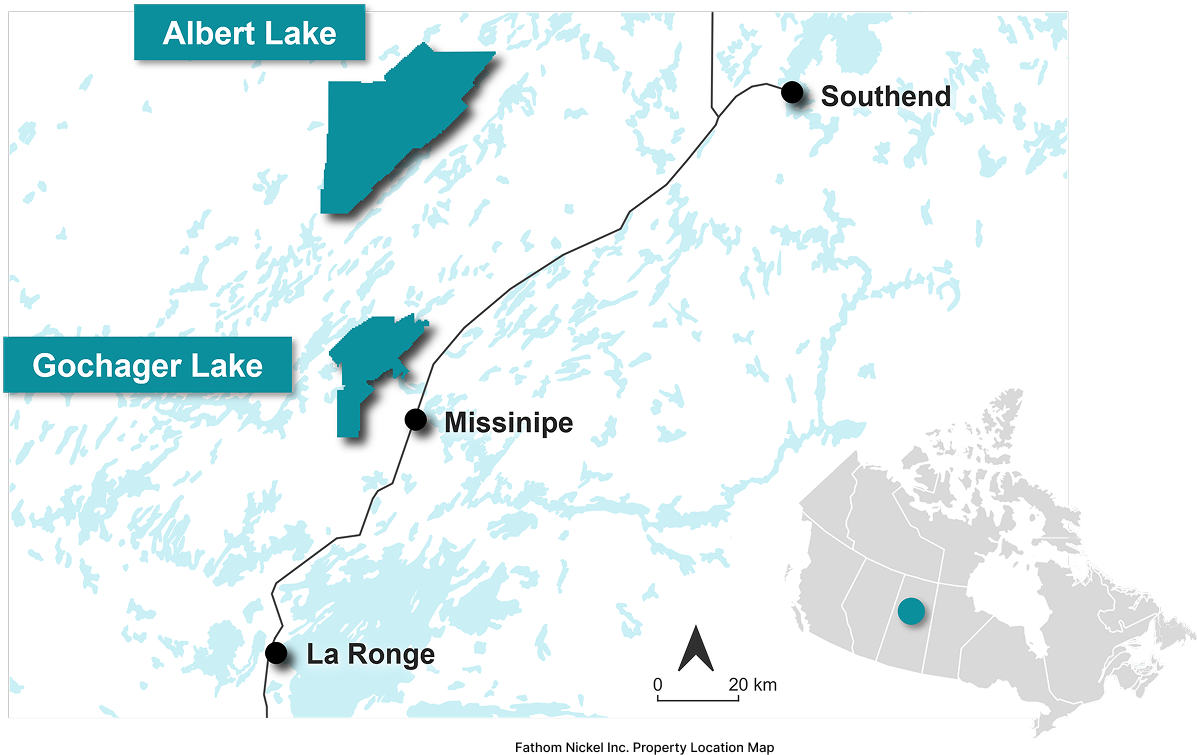
Fathom Nickel Inc. Property Location Map

Located within the magmatic nickel sulphide-rich Proterozoic Trans-Hudson Orogen, which extends across Saskatchewan into northern Manitoba and northern Quebec, Fathom’s projects cover a northeast-trending corridor of approximately 100 kilometres. Together, the three properties total more than 133,000 hectares. In Manitoba, the Thompson Nickel Belt has been in production since 1961, while in northern Quebec, the Raglan operations have produced high-grade magmatic nickel-copper-cobalt-PGE sulphides since 1997. Fathom’s exploration thesis is that Saskatchewan’s underexplored segment of the Trans-Hudson Orogen is equally fertile for magmatic nickel sulphide deposits as comparable districts in neighbouring Manitoba and Quebec.

There has been minimal follow-up exploration at the Albert Lake and Gochager Lake projects since the 1960’s. The limited work completed focused mainly on the historic deposits and did not assess the broader scale potential. Fathom is the first company to demonstrate that the host geology and mineralization styles at both projects are consistent with large, dynamic and open magmatic nickel sulphide systems.

Our Critical Minerals Projects
Gochager Lake Project

The 33,629-hectare Gochager Lake property is located 75 kilometers north-northeast of La Ronge and 22 kilometers west-northwest of Missinipe, Saskatchewan, Canada. Fathom owns 100% of the property and has been actively exploring it since February 2023. The property hosts the historic magmatic nickel-copper-cobalt sulphide Gochager Lake deposit [1] , which was defined by drilling between 1965 and 1968.

[1]- The Gochager Lake property is host to the historic Gochager Lake Ni-Cu deposit. There is no source or available Technical Reports to verify the historic resource estimate for the deposit; hence, Fathom will treat the historic estimate as an Exploration Target. Available records in the Saskatchewan Mineral Deposit Index (SMDI) and Saskatchewan Mineral Assessment Database (SMAD) suggest an Exploration Target of 4-5 million tons grading 0.3% Ni – 0.4% Ni and 0.08% Cu – 0.09% Cu. The potential quantity and grade are conceptual in nature, there has been insufficient exploration to define a mineral resource, and that it is uncertain if further exploration will result in the target being delineated as a mineral resource. At present, Fathom has drilled 16 drillholes (5,549m) into the historic Gochager Lake deposit and has confirmed Ni-Cu grades comparable to and higher than the historical grades reported, thus confirming that a deposit of Ni-Cu+Co metal accumulation does exist at the historic Gochager Lake property. The disclosed potential quantity and grade have been determined by historic records notably; the Saskatchewan Mineral Deposit Index and Saskatchewan Mineral Assessment Database. (SMDI #0880) reports delineation drilling outlined a deposit at the historic Gochager Lake Deposit; Steel, J.S. (1990), (SMAD 73P15-0091): Report on a Diamond Drilling Program on the Gallagher (Gochager) Lake Property of McNickel Inc., reported that Scurry-Rainbow Oil Ltd. constructed vertical sections and a longitudinal section from drill data collected 1966-1968, and an orebody with reasonably well-defined limits was interpreted. As stated above, the historic estimate is not well documented and there are no available Technical Reports to support the historic resource estimate(s).

Fathom Exploration 2023 – 2025

Exploration to date has focused on improving the understanding of the historic deposit, its host stratigraphy, and mineralization styles through drilling. Surface work has successfully identified and expanded the deposit-hosting stratigraphy along strike. The resulting deposit footprint, now traced for more than 8 kilometers, demonstrates the project’s scale potential, including the potential for additional high-grade magmatic Ni-Cu-Co sulphide deposits beyond the historic Gochager Lake deposit.

2023 Exploration:
  • Diamond drilling, 9 drillholes, 2,893 meters
  • Borehole electromagnetic (BHEM) surveys all drillholes drilled plus available historic drillholes.
  • Surface transient time domain electromagnetic (TDEM) surveys (8.9 ln-km).
  • Soil geochemistry (239 B-horizon samples), prospecting (14 grab, 7 portable x-ray fluorescence (pXRF) chip samples), geological mapping.
2024 Exploration:
  • Diamond drilling, 7 drillholes, 2,656 meters
  • BHEM and TDEM surveys (19.2 ln-km), Drone MAG survey (367.2 ln-km) centred over deposit area
  • Soil geochemistry (2,061 B-horizon samples), prospecting (50 grab samples, 582 pXRF chip samples), geological mapping

  • All-season 20–25-person, camp construction
2025 Exploration:
  • Soil geochemistry (3,448 B-horizon samples), prospecting (71 grab samples, 648 pXRF chip samples), geological mapping

  • Commenced winter trail access to the project
Project Exploration History
  • The most significant period of exploration occurred between 1965 and 1970 and resulted in the discovery of the Gochager Lake Ni-Cu-Co deposit and the discovery of the Mal Lake Ni-occurrence.
  • Historic drillhole I-12 drilled in 1967 at the Gochager Lake deposit intersected 290.4m grading 0.58% Ni, 0.11% Cu. The final 9.7 meters of this intercept had a weighted average of 2.36% Ni, 0.36% Cu and 0.14% Co.
  • The Mal Lake Ni-occurrence approximately 10 kilometers southeast of the Gochager Lake deposit, also drilled in 1967, returned drillhole intercepts up to 1.11% Ni, 0.24% Cu / 7.9 meters. The host rock and Ni:Cu ratio are analogous to the Gochager Lake deposit.
  • Review of historic Mal Lake drill core revealed Co is associated with the Ni-Cu mineralization.
  • The Borys Lake deposit initially discovered in 1956 is a VMS-style like setting (zinc-lead-silver) that has been mapped along strike for 3,800 meters. The current historic Borys Lake mineral reserve [2] was defined by drilling 1972.
  • In 2008 an airborne VTEM™ survey centred over the Gochager Lake deposit was flown and in 2013 a VTEM™ survey centred over the Borys Lake deposit was flown. In total approximately 325 square kilometers of airborne VTEM™ coverage.

[2] – The Gochager Lake property is host to the historic Borys Lake Zn-Pb deposit (SMDI#0848). There is no source or available Technical Reports to verify the historic resource estimate for the Borys Lake deposit; hence, Fathom will treat the historic estimate as an Exploration Target. Available records in the SMDI and Saskatchewan Mineral Assessment Database (SMAD) suggest an Exploration Target of 1-1.5 million tons grading 1.5%-2.0% combined Zn-Pb. The ranges of tons and grades are conceptual as there is insufficient historic data to verify the historical resource estimate(s) for the Borys Lake deposit. Fathom has confirmed the existence of drill core and exploration trenches within the Borys Lake deposit area and sampling of the trenches has confirmed the presence of Zn-Pb mineralization of comparable grade available in the public record, thus confirming that a deposit of Zn-Pb metal accumulation does exist at the historic Borys Lake deposit. Furthermore, no drilling has been done by the Company to define a current mineral resource, and it is uncertain if further drilling will result in the Exploration Target being delineated as a mineral resource. The disclosed potential quantity and grade is reported in the Saskatchewan Mineral Deposit Index (SMDI #0848). As stated above, the historic estimate is not well documented and there are no available Technical Reports to support the historic resource estimate.

Project Deposit Area Geology
  • The Gochager Lake project falls within the interpreted border of the Rottenstone and La Ronge Domain of the Proterozoic (1.8 – 2.0 Ga) Trans Hudson Orogenic (THO) belt.
  • The THO in neighbouring Manitoba and northern Quebec host Proterozoic, World Class nickel camps (Thompson, Lynn Lake, Raglan, Nunavik).

  • The property area is underlain by a monotonous succession of northeast-trending, heavily foliated biotite gneiss or biotite migmatite that contain scattered intrusive dioritic and gabbroic bodies that vary in size from 300m to 1.8km in length and are aligned with the regional northeasterly trend.

  • The historic Gochager Lake deposit is hosted within a chaotic, complex, steeply oriented intrusive suite composed of norite, variable-textured gabbro, gabbro and ultramafic rocks (pyroxenite) all contained within variable metasediments (paragneiss).

  • Pyrrhotite is the dominant sulphide mineral within the deposit, and occurs as massive stringers and veins, blebs, disseminations, and net-texture mineralization, as well as in a semi-massive to massive sulphide breccia form.

  • Pentlandite occurs as coarse disseminations within the pyrrhotite, and chalcopyrite is additionally present as stringers and interstitial blebs in low concentrations throughout the deposit.

  • Cobalt, a significant component to the Gochager style of mineralization, is directly associated with pentlandite.

Disseminated – blebby sulphide nodules mineralization Gochager Lake deposit

Semi-massive breccia sulphide pyrrhotite-pentlandite-chalcopyrite mineralization Gochager Lake deposit

Fathom Gochager Lake project 2023-2024 drillhole plan map

Gochager Lake Project nickel in-soil map

Albert Lake Project

The 90,460-hectare Albert Lake property is located 135 kilometers north-northeast of La Ronge, Saskatchewan, Canada. Fathom owns 100% of the property. As a private company, Fathom conducted intermittent exploration at the project from 2016 to 2018 and, as a public company, advanced exploration more aggressively from 2021 to 2024. The property hosts the historic Rottenstone Mine [3], a small operation that produced very high-grade nickel-copper-platinum-palladium-gold mineralization between 1965 and 1969.

[3] – The Rottenstone Mine; a small open-pit mining / milling operation was in production 1965-1969. Mining in 1965 produced 5,500 short tons with a reported average production grade of 3.23% Ni, 1.83% Cu, 0.14 oz/ton Pt, 0.10 oz/ton Pd, 0.03 oz/ton Au (9.26 g/t*3E, 3E = Pd-Pt+Au) and 0.20 oz/ton Ag. Initial milling of Rottenstone mine concentrate; September 5 – November 7, 1965, produced 1,070 dry short tons of concentrate that averaged 10.83% Ni, 5.74% Cu, 0.33 oz/ton Pt, 0.53 oz/ton Pd, 0.10 oz/ ton Au (32.91 g/t* 3E) and 1.25 oz/ton Ag.  Richards, B.R. and Robinson, B.G.W. (1966), Mining and milling a small ore deposit …. Rottenstone Mining Limited: The Canadian Mining and Metallurgical Bulleting for December 1966.  The Saskatchewan Mineral Deposit Index (SMDI) #0958 reports final mine production in 1969 of 28,724 tons with an average grade of 3.28% Ni, 1.83% Cu and 9.63 g/t 3E and that approximately 9,000 tons of concentrate were sold to the International Nickel Company of Canada Limited. * A factor of 34.286 g/tonne was used to convert 1 oz/ton to g/tonne (g/t).

Fathom Exploration 2016 – 2024

Fathom’s exploration at the Albert Lake project has been focused on demonstrating the small, very high-grade Rottenstone deposit is not a standalone, isolated deposit but a function of a large, open and dynamic magmatic nickel sulphide system. The “proof of concept”. Fathom is the first exploration company in the history of the project, dating back to 1929, to prove the Rottenstone deposit is part of a much larger dynamic system. New, separate discoveries of Rottenstone-like host rock and mineralization have been made 500 meters west-northwest of the Rottenstone mine (The Bay-Island Trend), 4.5 kilometers to the southwest of the Rottenstone mine (The Dime), and 1.5 kilometers southwest of the Rottenstone mine (Nic5 – Tremblay-Olsen). Ni-Cu+PGE-Au (platinum group elements + gold) magmatic sulphide mineralization is present at the three new discovery areas, all remain open for expansion, and in need of additional exploration programs.

2016 Exploration:
  • Diamond drilling, 11 drillholes, 467 meters
2017 Exploration:
  • Preliminary metallurgical study of Rottenstone deposit mineralization
2018 Exploration:
  • Soil geochemistry (1,478 B-horizon samples), prospecting (13 grab), geological mapping
  • Modeling of prominent 2008 VTEM™ conductors, drill target generation
  • Diamond drilling, 5 drillholes, 992 meters
  • BHEM surveys, new and historical drillholes
2021 Exploration:
  • Diamond drilling, 22 drillholes, 4,338 meters
  • Soil geochemistry (3,730 B-horizon samples), prospecting (57 grab), geological mapping
  • BHEM surveys, new and historic drillholes, 11.8 ln-km TDEM, and gravity survey (774 stations)
  • Airborne Gradient MAG survey, 9,595 ln-km
2022 Exploration:
  • Diamond drilling, 34 drillholes, 5,589 meters
  • Completed pXRF lithogeochemistry of historic drillholes (63 drillholes)
  • BHEM surveys, 43.3 ln-km TDEM
  • Soil geochemistry (1,003 B-horizon samples), prospecting (29 grab), geological mapping
  • Airborne AirTEM survey, 2,715 ln-km
2023 Exploration:
  • Diamond drilling, 2 drillholes, 701 meters
  • BHEM surveys, 38.0 ln-km TDEM, and gravity survey (507 stations)
2024 Exploration:
  • Diamond drilling, 6 drillholes, 1,386 meters
  • BHEM surveys, 9.3 ln-km TDEM, and gravity survey (167 stations)
  • Prospecting southern end of the property for Au, Ni-Cu+PGE potential.
  • 144 outcrop grab samples; 1 sample returned 2.68 g/t Au.
  • Mafic-ultramafic rocks encountered in area prospected.
Project Exploration History
  • The Rottenstone deposit high-grade nickel-copper + Pt-Pd was first recognized and drilled in 1929
  • With the advent of HWY 102 north of La Ronge circa 1948 came renewed interest in the Rottenstone deposit and surrounding area.
  • Mining of the Rottenstone deposit commenced 1965 and final shipment of Rottenstone mine concentrate was in the winter months of 1969.
  • In 1985 the historic Rottenstone mineral lease was made available and intermittent surface exploration (mapping, prospecting geophysics) was performed in the Rottenstone mine area through 1990.
  • Active exploration centred on the Rottenstone mine area and surrounds occurred 1998-2003 consisting of airborne biogeochemical survey, airborne geophysics, surface geophysics, soil geochemistry and diamond drilling (40 drillholes, 8,143 meters).
  • In 2008 a VTEM™ survey centred over the Rottenstone deposit area was flown (1,144 ln-km) and 7 drillholes (1,176 meters) tested several conductors outlined by VTEM™ survey.
Project Deposit Area Geology
  • The Albert Lake project falls within the Rottenstone Domain of the Proterozoic (1.8 – 2.0 Ga) Trans Hudson Orogenic (THO) belt.
  • The THO in neighbouring Manitoba and northern Quebec host Proterozoic, World Class nickel camps (Thompson, Lynn Lake, Raglan, Nunavik).
  • The property area is underlain by a broad belt of early to late syntectonic, northeast trending arcuate tonalite to granite intrusive rocks with associated injection migmatites.
  • The historic Rottenstone deposit is hosted within an ultramafic sill-like body occurring within metasedimentary supracrustal rocks.
  • Net-texture sulphides (pyrrhotite-pentlandite-chalcopyrite) dominate the Rottenstone mineralization. Massive sulphide has been observed in rock samples surrounding the historic Rottenstone mine workings.
  • Very high PGE grades along with high metal tenors define the Rottenstone-style mineralization.

Typical Rottenstone mine / deposit net-texture sulphide mineralization

Rottenstone-like disseminated-blebby and net-texture sulphide mineralization, Bay-Island Trend 500m west-northwest of the Rottenstone deposit

South Albert Lake project 2024 prospecting sample location map